When Balance Cost Lives
The Beast King knew the numbers before the smoke rose.
He did not count in coins or banners or oaths. He counted in migrations. In prey-density. In
predator range. In how long a river could sustain antler and hoof before it choked itself on its
own abundance.
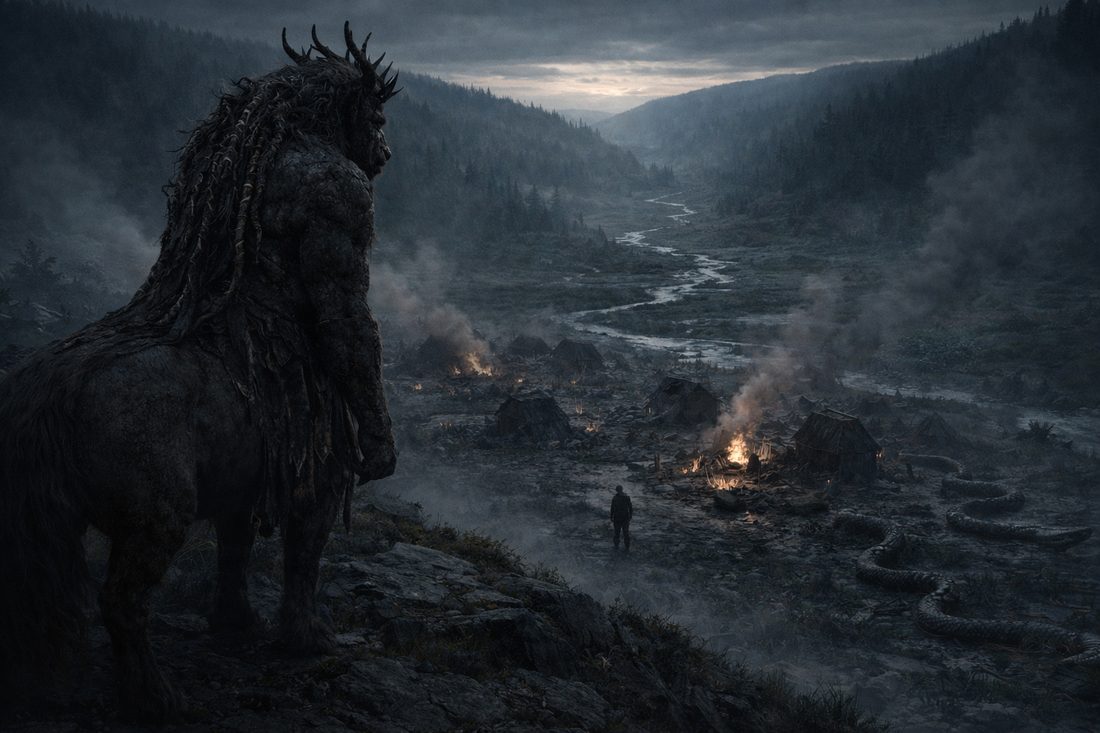
The village had been built three winters ago.
Too close to the migration corridor. Too near the marsh where the serpents had once nested.
The humans had not meant harm. They had cut trees, raised huts, dug irrigation channels with
a kind of desperate hope.
Hope always builds quickly.
Balance does not.
The scouts brought word at dusk.
“Serpents,” one said.
“Not many,” said another.
“Enough.”
The Beast King stood upon the ridge and watched the smoke.
The serpents were not coordinated anymore. The great tether had been severed. They were
slower now. Hungrier. Territorial. Reduced to instinct and scale.
Which made them more predictable.
Which made them manageable.
If managed correctly.
Behind him, the younger warriors pawed the ground. “We can reach them before midnight.”
“We will lose three,” the Beast King said without turning.
Silence.
“And if we intervene,” he continued, “we drive the serpents west.”
“To the marsh?”
“Yes.”
“And if they reach the marsh?”
“The marsh floods next season.”
“And if the marsh floods?”
“The plains starve.”
The youngest warrior swallowed. “So we save them.”
The Beast King turned then. His eyes were old, not tired. There is a difference.
“If we save them,” he said evenly, “we lose the winter herds. If we lose the winter herds, we lose
five villages next year.”
He did not say human villages.
He did not say centaur villages.
Balance did not recognize such distinctions.
From the ridge, the humans’ torches flickered like frightened stars. Shouts carried faintly across
the valley. A child’s cry rose once, then was cut short.
The Beast King closed his eyes.
He did not pray. The Prime Gods did not answer such questions. They corrected large
distortions. This was not large. This was arithmetic.
“Hold position,” he said.
One of the elders stepped forward. “You will be blamed.”
“Yes.”
“They will say we abandoned them.”
“Yes.”
“They will not understand.”
“No.”
Below, a hut collapsed in flame.
The Beast King watched the serpents coil through smoke. He marked their path. He memorized
which direction they favored. He would hunt them later. He would thin them carefully. He would
ensure they did not grow bold.
But he would not save the village.
Not tonight.
By dawn, the fire had burned itself to ash. The serpents had fed and withdrawn toward stone.
The Beast King descended the ridge once the last coil vanished.
The humans who survived stared at him with hatred.
“You were there,” one whispered.
“Yes.”
“You watched.”
“Yes.”
“Why?”
He did not offer them philosophy. He did not speak of migration corridors or flood cycles.
He looked at the charred ground and said only, “Because if I had moved, more of you would die
next winter.”
They did not believe him.
He did not require belief.
He ordered his warriors to carry the wounded to safer ground. He left meat and water. He
marked the serpent trails in his memory.
And when he turned away, the youngest warrior asked quietly, “Does it ever get easier?”
The Beast King did not answer immediately.
He watched the sun rise over a valley that would now recover faster than it would have.
“No,” he said at last.
“Good.”
The warrior looked confused.
The Beast King did not explain.
Balance is not mercy.
It is cost allocation.
And someone always pays.
Good.
Now we wound the reader properly.
Not with fire.
Not with slaughter.
With help.
End of When Balance Cost Lives