King Solomon
He did not arrive with an army.
He arrived with gifts.
The human kingdom had carved itself from exile stone and stubborn soil. Their cities were not
elegant like elven terraces nor vast like Beast King dominions. They were deliberate. Built with
hands that knew loss.
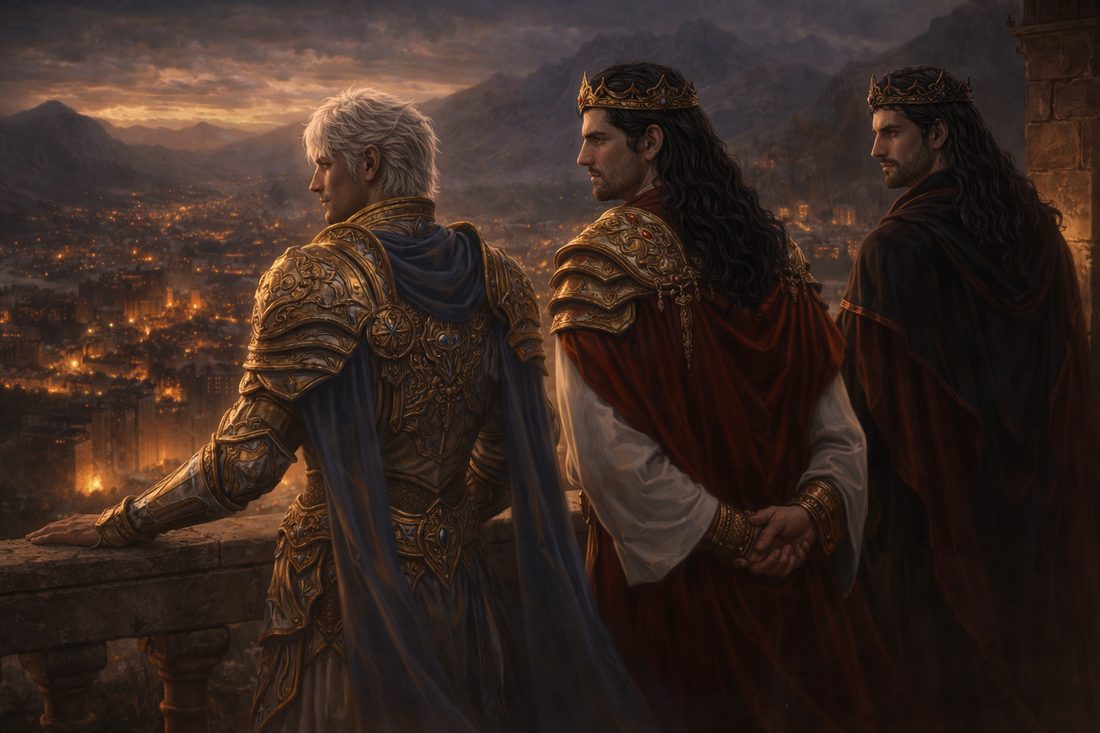
Adamas ruled from a high citadel overlooking terraced fields and disciplined streets. His
immortality had been stripped, but time still treated him strangely. His white hair had grown
longer. His face had hardened. But he did not bend.
When Solomon entered the capital, he wore white robes threaded with quiet gold. No crown. No
visible weapons. Only a retinue small enough to suggest respect rather than dominance.
The people bowed.
Not in worship.
In uncertainty.
The Gods Blood were not human. Not fully. They were descendants of avatars who had once
carried divine presence through mortal flesh. They did not age normally. They did not break
easily.
They also did not belong to any one race.
That unsettled everyone.
Adamas received Solomon in the open court rather than the throne hall.
A message.
We are not your subjects.
Solomon inclined his head as if the choice pleased him.
“Your city grows,” he said.
“It endures,” Adamas corrected.
Their eyes met.
Two long-lived beings.
Two different evolutions of intervention.
Behind Solomon stood Lazarus in black robes, silent as a drawn blade. His expression did not
soften when he looked upon the human banners.
He did not believe in this kingdom.
Solomon did.
Or rather, he believed in what it could become.
They walked the parapets together as the sun lowered behind the mountains. Below them,
human soldiers drilled with disciplined rhythm. Markets closed with efficiency. Children practiced
both sword and script.
Adamas watched his people.
Solomon watched Adamas watching them.
“You have done what no race expected,” Solomon said quietly.
“We survived,” Adamas replied.
“You built,” Solomon corrected gently.
Adamas did not answer.
He knew praise when he heard it.
And he knew positioning when he felt it.
“You are still strong,” Solomon continued. “But strength carried by one man is a narrow bridge.”
There it was.
Not threat.
Observation.
Adamas’s jaw tightened slightly.
“I will not live forever,” he said.
“No,” Solomon agreed. “And that is precisely the point.”
Lazarus shifted behind them, impatience barely contained.
Solomon continued in that same measured tone.
“The Titans will not descend again. The elves will not steward you. The Prime Gods have
withdrawn into correction cycles. Humanity stands alone.”
“We have stood alone before,” Adamas said.
“Yes,” Solomon replied softly. “But never without immortality.”
Silence stretched between them.
This was not an offer of conquest.
It was an offer of continuity.
“You and I,” Solomon said, “are both products of intervention. The difference is structural.
Humanity relies on extraordinary individuals. My kind does not.”
Adamas turned to face him fully.
“And what is it you are suggesting?”
Solomon’s expression did not change.
“Alliance,” he said.
“Integration.”
“A future where humanity does not gamble its survival on singular heroes.”
“And who defines that future?” Adamas asked.
Solomon met his gaze without flinching.
“We do.”
Not I.
We.
Lazarus’s eyes flickered at that word.
Adamas studied him for a long moment.
“You would have my people kneel.”
“No,” Solomon said calmly. “I would have them evolve.”
The difference was almost invisible.
Almost.
Below them, a child dropped a wooden sword and picked it up again stubbornly. A human habit.
Fall. Rise. Repeat.
Adamas saw it.
Solomon saw Adamas see it.
“I will not surrender sovereignty,” Adamas said at last.
“I would never ask you to,” Solomon replied.
And he meant it.
Not yet.
They spoke of trade. Of shared borders. Of military cooperation. Of education exchanges
between human scholars and Gods Blood archivists.
Nothing binding.
Nothing coercive.
Everything incremental.
When Solomon departed days later, the people spoke well of him.
He had been respectful.
Measured.
Visionary.
Lazarus, however, did not look back at the city as they rode away.
“It will not submit willingly,” Lazarus said.
“It does not need to,” Solomon answered.
“They trust you.”
“For now.”
“And when Adamas dies?”
Solomon’s gaze remained forward.
“Then they will need structure more than pride.”
Far beneath the earth, in places where law bent and pressure gathered, something listened.
Solomon did not pray.
He did not invoke.
He did not bargain.
But there was something in him already aligned with inevitability.
He did not hate humanity.
He feared its fragility.
And fragility must be replaced before it collapses.
In the citadel, Adamas stood alone long after the Gods Blood had vanished from sight.
He did not fear Solomon.
He feared being right about him.
Because the most dangerous man is not the one who wants power.
It is the one who believes power is the only mercy left.
End of King Solomon