The Blessing That Wasn’t Asked For
The boy did not think of it as power.
He thought of it as irritation.
The fever annoyed him.
That was the part he would never admit.
The village lay low in the valley where fog lingered too long in the mornings. Timber walls,
smoke-stained roofs, fences repaired more often than replaced. Humans built as if time were
short. Because for them, it was.
Mara had always moved slowly.
Not frail. Not weak. Just deliberate.
She had buried a child once. Survived winter sickness twice. Laughed louder than most men at
the harvest fires. The kind of woman who endured without announcing it.
The fever came quietly.
It began as warmth beneath the skin. Then heat. Then trembling that shook her bones until
even breathing became work.
They did not send for help.
They did not want help.
They wrapped her in wool and waited.
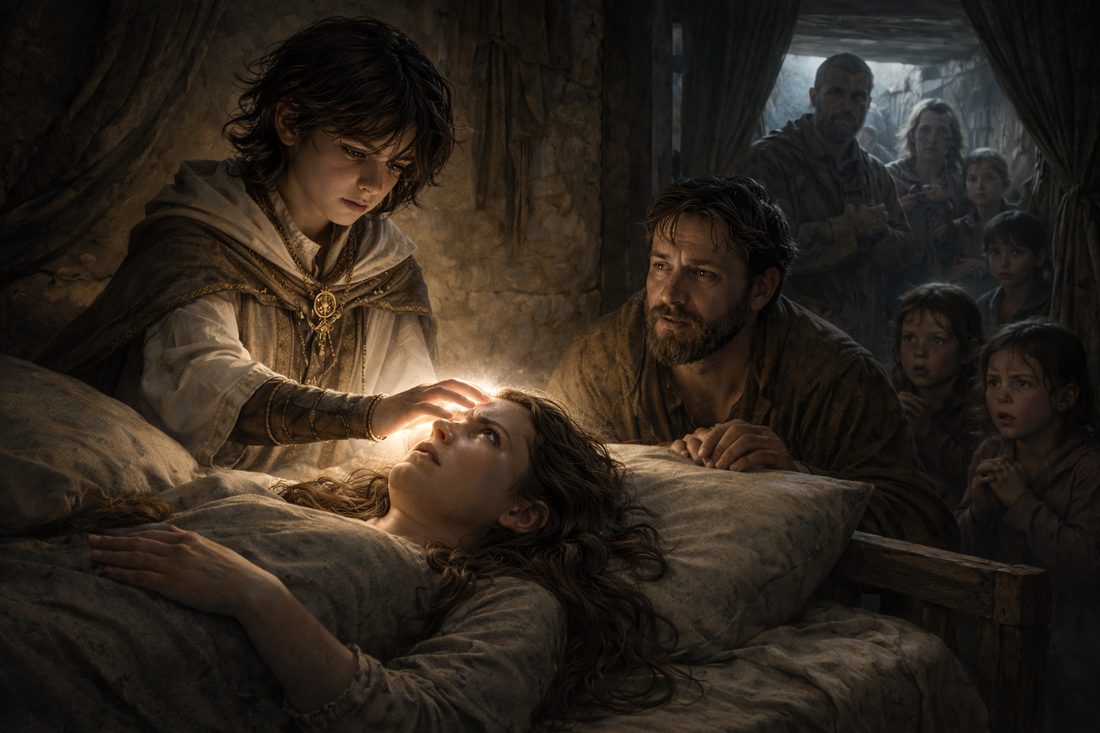
The boy arrived at dusk with dried meat and mountain salt. Twelve years old. Dark hair falling
into eyes too bright for his age.
People said there was something strange about him.
Not dangerous.
Not yet.
Just… sharp.
He stepped into the house and felt it immediately.
The room was wrong.
Not morally wrong.
Pattern wrong.
The air around Mara quivered to him, like a fabric pulled unevenly across a frame. He could not
see it. He could not name it.
He only knew it irritated him.
She was misaligned.
Her pulse struck the air like a drum out of rhythm.
The boy stepped forward.
“Don’t,” her husband said, but the word lacked force.
The boy did not ask permission.
He placed his hand above her brow.
He did not chant.
He did not call.
He corrected.
The room tightened.
For a single breath, every object felt precisely where it belonged. The fire steadied. The
shadows sharpened. Even the dust in the air seemed to settle into clarity.
Mara’s body arched once.
Then stilled.
The heat vanished.
The trembling ceased.
Her breath deepened into calm, even cycles.
The boy blinked.
He had not expected it to resolve so cleanly.
Behind him, someone sobbed in relief.
“She’s healed.”
“Blessed child.”
“Gods Blood.”
The word spread through the room like oil catching flame.
Mara’s eyes opened.
They were not fever-bright.
They were clear.
Too clear.
She sat up without effort.
No weakness. No ache. No lingering exhaustion.
The fever had not faded.
It had been erased.
She looked at the boy.
“What did you do?”
He smiled nervously.
“You were sick.”
“Yes.”
“Now you’re not.”
She pressed her palm against her chest.
There was no pain there.
But something was missing.
“I had already said goodbye,” she said quietly.
The room stilled.
The boy frowned.
“You were dying.”
“I know.”
“And now you won’t.”
She studied him carefully.
“You decided that.”
The word landed heavier than accusation.
Decided.
Her husband stepped forward.
“He saved you.”
Mara did not look at him.
She looked at the boy.
“When the fever was at its worst,” she said, “I stopped fighting.”
Her voice did not tremble.
“I let it take me.”
The boy’s smile faltered.
“I fixed it.”
“Yes,” she said. “You did.”
She swung her legs over the bed and stood.
Too smoothly.
The illness had hollowed her for weeks. That weakness should have lingered. Recovery should
have been gradual.
Instead she felt… optimized.
Her grief for leaving her children.
Gone.
Her fear.
Gone.
Even the strange, calm acceptance she had reached.
Gone.
The ending had closed.
He had reopened it.
“I was ready,” she said.
The boy stepped back.
“You’re better.”
“Am I?”
He opened his mouth.
Nothing came.
Outside, villagers gathered quickly. Word traveled faster than smoke. They called it miracle.
They called him chosen.
The boy felt their attention and something inside him straightened.
Yes.
This was right.
He had removed imbalance.
Mara stood apart from the crowd, watching him.
She did not hate him.
She feared what had not occurred to him.
He had not asked.
He had not hesitated.
He had not considered that death might belong to her.
Over the next weeks, he corrected more things.
A snapped bone realigned without scar.
A harvest blight vanished in a single afternoon.
A man with failing lungs breathed easily again.
Each time the world felt clearer around him.
Each time the adjustment required less effort.
Each time someone said thank you.
And each time he spoke the same words before acting.
“Let me.”
“Trust me.”
“It will be better.”
Most people did.
Why refuse improvement?
Why cling to weakness?
High in the mountain halls of the Gods Blood, news reached ears that listened carefully.
They did not call it arrogance.
They called it refinement.
They did not call it trespass.
They called it structural correction.
One elder remarked quietly, “He does not wait for consent.”
Another replied, “He will not need to.”
Mara lived many years after that.
Longer than the fever would have allowed.
Longer than she once expected.
She never again felt fully certain that her body belonged to her.
Because she knew something most of the village did not.
The boy had not fought the fever.
He had overruled it.
And if he could overrule death,
What else might he overrule when convinced it was inefficient?
That was how it began.
Not with armies.
Not with chains.
With help.
Precise.
Effective.
Unquestioned.
And quietly, inevitable.
End of The Blessing That Wasn’t Asked For