Blood That Answers
The first time it happened, they told the boy to say nothing.
He had been racing another child along the outer parapet of Heavens Throat, where the white
stone dropped into mist without mercy. The southern peaks did not forgive missteps. That was
why they had chosen them. Stone did not flatter. Stone did not negotiate.
He slipped.
There was no scream. No flailing. Just absence where a body had been.
Those who watched expected the distant sound of impact.
Instead they heard it immediately.
A crack of stone.
They rushed to the lower terrace and found him standing in a shallow crater, marble split
beneath his heels. Dust clung to his hair. His breath came fast, more from surprise than pain.
There was no blood.
No broken limb.
Not even the stunned confusion of someone who had nearly died.
He looked up at them and frowned slightly, as if something had inconvenienced him.
The elders dismissed it publicly as luck. A fortunate angle. A jut of stone hidden in fog.
Privately, they began paying attention.
Heavens Throat had never been an empire. It had been a retreat built from necessity and
exclusion. The descendants of the Avatars had learned early that the world did not know what to
do with them. Elves treated them as unfinished stories. Beast Kings regarded them with
measured suspicion. Humans admired and resented them in equal measure.
So they went upward.
They carved white halls into the southern peaks because height gave distance. They built
terraces that caught the sun because light revealed fractures. They trained because training
was simpler than belonging.
For generations they told themselves they were preserving something sacred. The blood of
those who had once carried divinity through mortal flesh. Not gods. Not angels. But touched by
something older than either.
It was Solomon who first noticed the pattern without romanticizing it.
He was not king yet. Not even close. He moved quietly through the training courts and archives,
listening more than speaking. Where others saw isolated incidents, he saw repetition.
The second time it happened was not survival but response.
A young woman in the lower court had been failing for weeks. Flame would not answer her call.
Light would not gather in her palms. Her frustration built until discipline cracked.
She screamed.
The air tightened.
Not with heat.
With precision.
The stone beneath her feet shifted by a fraction, aligning her stance perfectly. A crosswind that
had been throwing her balance slid behind her shoulders. Her breathing synchronized with
something outside herself, deeper and steadier.
When she struck again, the practice pillar split cleanly.
The instructor stared at the ground, then at her hands.
“Do it again,” he said.
She tried.
Nothing.
It had not been summoned.
It had been triggered.
Solomon watched from the upper stair and felt the smallest tremor of understanding. It was not
power in the way stories described power. It did not blaze or roar. It corrected.
Under strain, their blood did not produce miracles.
It reduced inefficiency.
The storm confirmed it.
It rose from the southern sea with a violence that made even dragon riders reconsider flight.
The Tylons had warned of pressure shifts. Moon Elves had reported strange disturbances in
tidal rhythm. Something in the sky was misaligned.
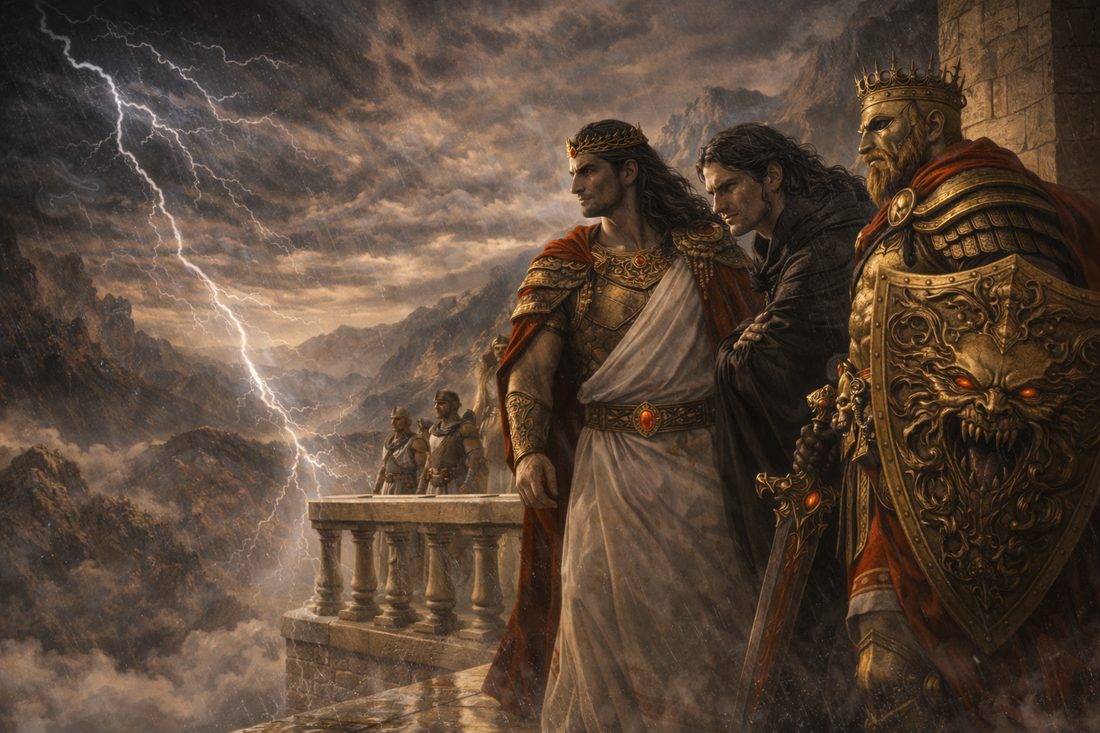
The Gods Blood gathered on the highest terrace, more out of instinct than ceremony.
They did not chant.
They did not pray.
They stood.
Lightning forked downward and curved at the last instant, shearing away from the peak. Rain
split around the terraces in invisible seams. Wind struck the mountain and slid aside as if
encountering a surface too exact to disrupt.
Solomon felt it like a change in weight behind his eyes.
The storm did not obey them.
It accommodated them.
Behind him, Lazarus stepped forward, dark robes snapping in the wind, eyes bright with
something harder than awe.
“It recognizes us,” Lazarus said.
Solomon did not look at him. “It responds.”
“That is the same thing.”
“No,” Solomon replied quietly. “It is not.”
Caligular laughed from the far edge of the terrace, where he stood broader and less restrained
than either twin. “If it responds, it yields. And if it yields, it acknowledges hierarchy.”
Solomon turned then, studying him.
“Or compatibility.”
Caligular’s smile thinned. “Compatibility is hierarchy that refuses to admit itself.”
That conversation did not end that day. It simply sank roots.
The Law of Divine Distance bound Titans and gods from descending directly into mortal affairs.
It was a fracture in reality sealed with cost and decree. But the Law did not bind residue. It did
not forbid blood already altered.
They were mortal.
They could bleed.
They could die.
But while they lived, the world seemed more willing to adjust around them.
That realization tasted different to each of the three.
To Lazarus, it tasted like urgency.
To Caligular, it tasted like entitlement.
To Solomon, it tasted like structure.
They began sending envoys north with measured language and open hands. Not demands.
Offers.
“We carry what your ancestors once carried.”
“We can stabilize the world.”
“We can prevent the next fracture.”
The elves declined without hostility.
“The world does not require overseers,” Hansall’s envoy replied. “It requires balance.”
The word lingered like grit between teeth.
Balance suggested stasis. Balance implied restraint. Balance felt like fear of escalation
disguised as wisdom.
The first disappearance occurred in snow.
An elven hero who had challenged their proposals too sharply during council failed to return
from a mountain crossing. The avalanche that took him was small. Precise. As if the mountain
had exhaled in exactly the right direction.
There were no witnesses.
There was no proof.
Only absence.
Caligular did not hide his satisfaction.
Lazarus said nothing.
Solomon did not ask who had ordered the patrol that day.
He only noted how cleanly it had occurred.
They tested Adamas once.
They did not announce it as a test. They called it positioning.
A formation of their strongest descended into a valley where human and elven settlements
bordered each other uneasily. They expected resistance. They did not expect singularity.
Adamas stepped forward alone.
White hair caught the light like frost. Armor scarred but unbowed. The spear in his hand moved
without flourish.
The air thickened around him, not bending but solidifying.
Each strike ended something with final clarity. There was no excess. No spectacle. Only
decision.
The Gods Blood retreated before the third rank fell.
Not in fear.
In calculation.
Back in the high council chamber carved into living rock, Lazarus struck the stone table hard
enough to fracture its edge.
“He is a bottleneck,” he said. “As long as he stands, no system will replace him.”
Caligular leaned forward. “Then remove him.”
Solomon’s voice cut through them both.
“No.”
They turned.
“He unifies opposition,” Solomon continued. “Remove him now and we inherit chaos. Chaos
cannot be governed.”
Caligular’s jaw tightened. “You would wait.”
“I would let time do what we do not need to.”
Lazarus’s gaze sharpened. “And if time does not move quickly enough?”
“It always does,” Solomon replied.
He did not say that Adamas was mortal now. Not fully ageless. Not fully divine. He did not need
to.
Years passed.
Language shifted.
They stopped calling themselves stewards.
They began calling themselves inheritors.
Training intensified. Ranks formalized. Heavens Throat grew walls that were less about defense
and more about permanence.
Under pressure, the blood answered faster.
Blades dulled more slowly in certain hands. Wounds closed cleaner. Storms curved wider.
Patterns revealed themselves earlier.
Expectation became pressure.
Pressure became doctrine.
Caligular began speaking openly of lesser races, of inefficiencies in elven restraint and human
volatility. He believed the answer in their blood proved mandate.
Lazarus reorganized the council into something harder, more centralized. He believed hesitation
was the true enemy.
Solomon drafted laws.
He codified response into structure.
He spoke rarely of dominance.
He spoke often of inevitability.
One evening, as the sun bled red across the southern peaks, Lazarus stood beside him on the
highest terrace.
“It answers us because we are meant to rule,” Lazarus said.
Solomon watched the clouds move below them.
“It answers because we are aligned,” he said.
“And alignment implies superiority.”
“Superiority,” Solomon replied softly, “is a consequence. Not a right.”
He did not yet believe in conquest.
He believed in replacement.
He believed that systems that relied on singular heroes would collapse.
He believed that blood which answered under strain should be structured before it demanded
obedience outright.
Far beneath the mountain, in deeper strata where older laws still coiled and listened, something
shifted.
Not summoned.
Not commanded.
Just attentive.
Blood that answers long enough begins to expect agreement.
And when expectation hardens, it no longer feels like ambition.
It feels like correction.
Heavens Throat stood silent above the world, white against storm and sun alike, patient as
stone.
But stone, too, reshapes valleys over time.
And time was already on their side.
End of Blood That Answers