The First Funeral
They did not know what to do with the body.
That was the first problem.
Abel lay on the grass where he had fallen, his blood darkening the roots of the garden trees.
The Fae wards did not react. The Eternal circuit did not stir. No light lifted him. No whisper came
to guide him home.
Nothing happened.
The Elves stood back at first, not out of cruelty, but confusion. Death among the Fae was not
like this. When an Elu died, the soul loosened, folded inward, and passed along familiar paths.
Memory returned to the Eternal Realm. The body became an echo, then a relic.
Abel did not loosen.
Evalon knelt beside him, hands shaking, pressing her palms to his chest as if warmth alone
might convince him to breathe again. She whispered his name until her voice broke. She did not
scream. She did not curse.
She waited.
Adamas stood behind her, unmoving. His shadow fell across his son’s face, and for the first time
since his creation, Adamas felt something inside him fracture without breaking. He had been
told humanity would endure. No one had explained what endurance felt like in the moment it
began.
Cainan was nowhere near the body. He stood at the edge of the clearing, arms crossed tight,
eyes fixed on nothing. His breathing was too steady. That steadiness frightened the Elves more
than any outburst would have.
High King Hansall arrived last.
He had walked the Garden for centuries. He knew every ritual grove, every place where grief
could be guided into meaning. He knelt opposite Evalon and examined Abel with a healer’s
care.
Then he closed his eyes.
“There is no return path,” he said quietly.
The words fell heavier than any accusation.
Evalon looked up at him. “What do you mean, no path.”
Hansall searched for something gentler and found nothing. “Your people were not woven into
the Eternal circuit. When our dead fall, we know where they go. Your son…”
He stopped.
Adamas understood before the sentence finished.
“He might be nowhere,” Evalon said.
Hansall did not deny it.
The Elven elders gathered then, murmuring among themselves. Some spoke of the Ghost
Realm, recently shaped by Thanatos, but no one knew if human souls could reach it. Some
argued for waiting. Some argued for intervention.
Waiting felt like cruelty.
The humans began to panic.
Abel’s siblings clustered together, whispering prayers they had not been taught, inventing
comfort as they went. A few tried to touch the body and recoiled, not from cold, but from the
wrongness of it. This was not sleep. This was not rest.
This was absence.
When night fell, the Garden lights dimmed instinctively. The moon rose. Still, nothing came for
Abel.
Evalon finally stood.
“If we do nothing,” she said, her voice hollow, “he will vanish.”
No one contradicted her.
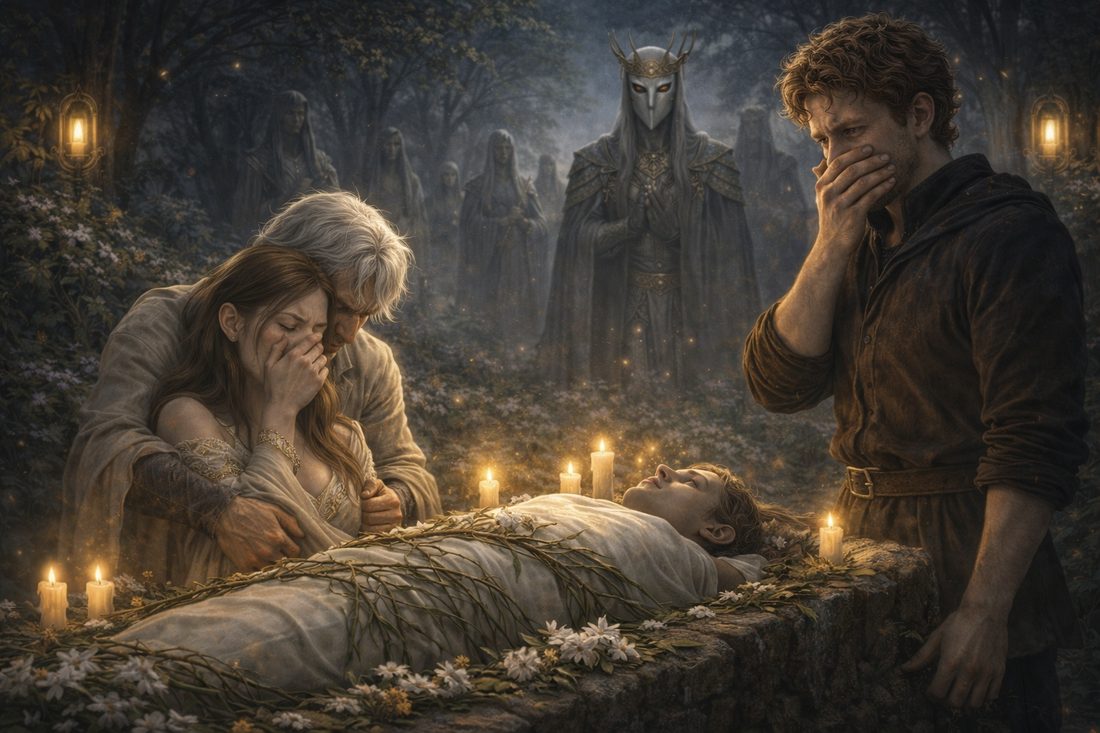
The funeral was improvised.
They wrapped Abel in woven leaves and mooncloth, because those were the only materials
meant for passage. The Elves sang a song of return that did not take hold. The notes slipped off
the air, unanchored.
Adamas carried his son himself.
When they placed Abel into the earth, the soil resisted. Roots curled back. The Garden did not
want this thing placed within it. Death was not meant to stay here.
Evalon collapsed beside the grave and pressed her forehead into the ground.
“Where did you go,” she whispered. Not as a question. As an accusation against the universe.
That night, no one slept.
The humans sat together, afraid to close their eyes in case something else was taken while they
were not looking. The Elves kept watch, uneasy in a sanctuary that suddenly felt incomplete.
Somewhere beyond the Garden, something listened.
By dawn, Evalon had made up her mind.
The terror of not knowing was worse than any price that certainty might demand.
And the world, which had until now only watched humanity learn, leaned closer.
Because the first death never belongs only to the dead.
It teaches the living what they are willing to trade to make it stop.
End of The First Funeral