Abel Walks Too Far
Abel learned the paths of the Garden faster than any human child should have.
Not the roads. Not the terraces or the streams that humans were permitted to walk. He learned
the narrow places. The soft crossings where moss grew over old wards. The pauses in birdsong
that meant the Fae were near but not watching.
The Elves noticed.
They did not forbid him.
Abel listened when they spoke, even when they spoke in ways that were not meant for him. He
did not ask why the trees bent when certain words were said, or why the light changed tone
near the inner sanctuaries. He accepted it the way one accepts weather.
That was why they liked him.
It was not affection at first. It was recognition.
He carried no hunger for power. No impatience. When the Elu taught him to shape breath into
focus, he did not push further. When they told him a story and stopped halfway, he did not
demand the ending.
Cainan noticed that too.
“You walk like them,” Cainan said once, watching his brother return from the deeper groves.
“You barely touch the ground.”
Abel smiled. “They taught me how not to disturb things.”
“They,” Cainan repeated. He made it sound smaller than it was.
Their parents said nothing. Adamas watched with pride tempered by caution. Evalon worried,
but softly. Abel had always been gentle. Gentle children, she believed, needed wide spaces.
Cainan did not walk with Abel anymore.
Among the humans, whispers formed. Not accusations. Comparisons.
Abel was invited to Elven rites where humans were usually asked to wait. Abel learned the
names of stars before the rest of them learned the names of hills. Abel spoke words that made
Fae elders pause, not because they were wrong, but because they were placed correctly.
“Why him?” someone asked once, not unkindly.
Cainan heard it.
He heard all of it.
The Elves did not see the difference growing. To them, Abel was a bridge. Proof that humanity
could listen without needing to conquer. Hansall himself once placed a hand on Abel’s shoulder
and said nothing at all, which was more honor than most received.
That was when the fracture became real.
“You belong with us,” Cainan said one night, standing at the edge of the human quarters. “Not
with them.”
“I am with us,” Abel replied. “I just stand closer to the middle.”
“There is no middle,” Cainan said. His voice was steady. “There is what we are. And what we
are not.”
Abel looked past him, toward the inner glow of the Garden. The trees there did not shimmer.
They breathed.
“They are not our enemies,” Abel said. “They never were.”
Cainan laughed once, sharply. “You sound like you have already chosen.”
Abel did not answer.
That silence stayed.
The next days were heavier. The Garden felt tighter. Humans gathered among themselves more
often. Elves watched with concern they did not yet name.
Abel was invited deeper than before.
Not as a ceremony. As a trust.
He walked where humans had never walked. He saw things he did not speak of. When he
returned, something in his posture had changed. Not pride. Alignment.
Cainan saw it immediately.
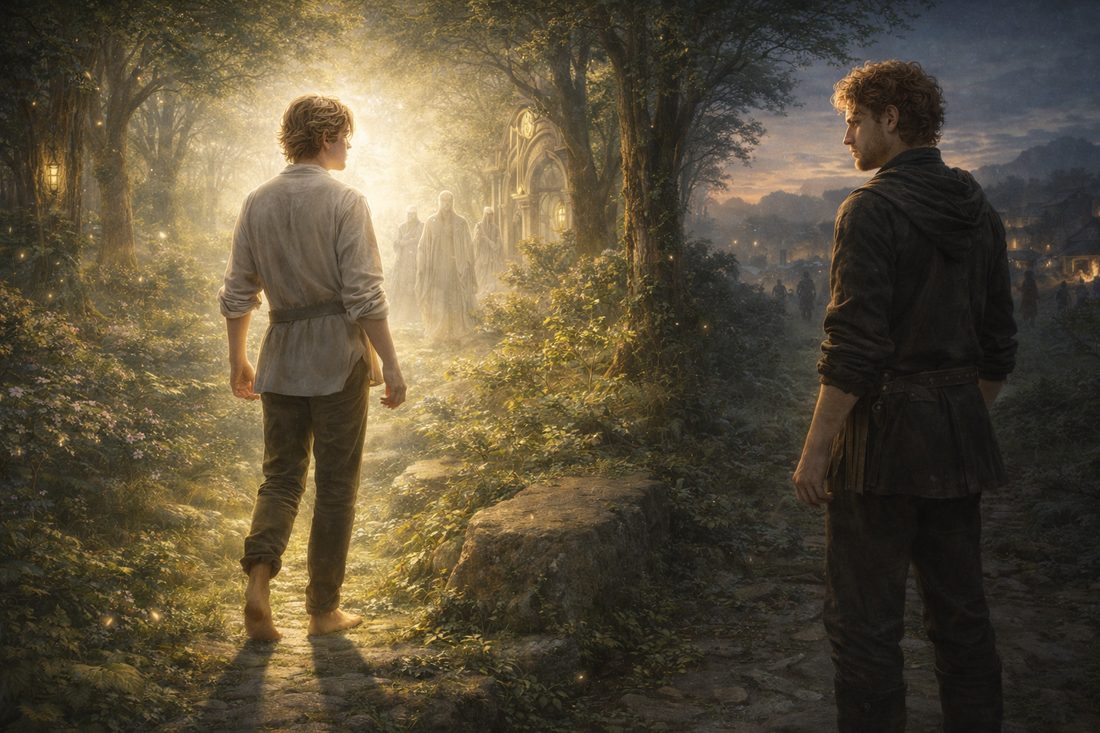
That night, Abel stood at the edge of the Garden. One foot on stone. One foot on grass that
remembered older laws.
Cainan followed.
“You should not be here,” Cainan said.
“I know,” Abel replied.
“Then turn back.”
Abel hesitated.
Behind him, the Garden waited. Before him, humanity watched from a distance that felt colder
than exile.
He took one more step forward.
And Cainan understood, with terrible clarity, that his brother would never belong entirely to one
side again.
The wind stilled.
Somewhere in the Garden, a ward tightened.
And the world leaned forward, holding its breath.
End of Abel Walks Too Far