The Nine Thrones Do Not Comfort
The scribe had believed the Acropolis would be silent.
That was the first mistake.
Silence implies absence. The Throned Acropolis was full. Not with voices, not with movement,
but with pressure. A weight that did not push down, but inward, as if the air itself were
considering whether he deserved to remain shaped like a person.
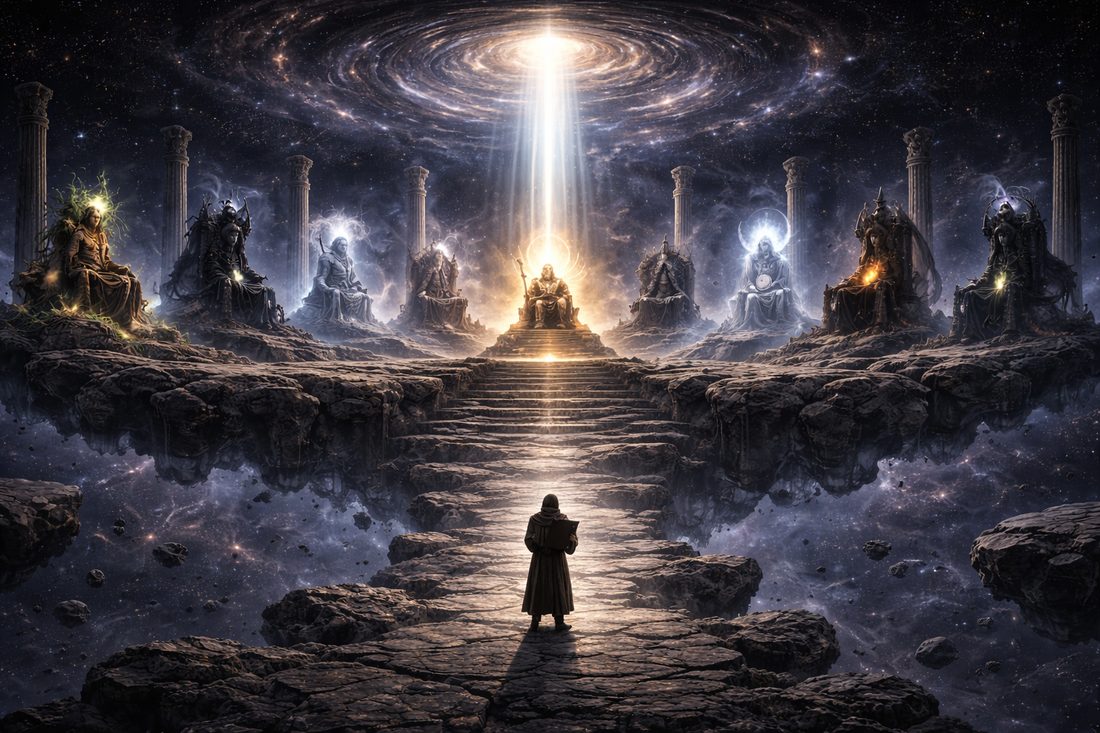
He stood at the outer ring, tablet pressed to his chest, feet aligned precisely with the runes cut
into the stone. He had been instructed never to step beyond the third concentric circle unless
summoned. He had also been instructed not to look directly at the thrones while they were
empty.
They were not empty now.
Nine stairways rose from the central dais, evenly spaced, identical at their base. Plain stone.
Unadorned. Deceptively merciful. From a distance, one might believe the thrones were unified,
equal, even fair.
That illusion lasted exactly three steps.
When the first Titan ascended, the air around that stairway changed.
Not theatrically. Not with thunder or flame. Reality simply… recalculated.
As the steps climbed, the space around the throne began to pull inward, folding like fabric drawn
through a ring. Light bent. Distance shortened. The stone beneath the scribe’s feet grew warm,
then unbearably bright, though he had not moved.
By the time the Titan reached the summit, the throne was no longer seated in the Acropolis.
It was seated in something else.
A vast expanse of burning gold surrounded it, a sky without horizon, radiant and distant. The
throne itself seemed carved from compressed sunlight, edges too sharp for the eye to rest on.
Angels did not sing. They stood, perfectly still, forged rather than born.
This was not a place of welcome.
It was a place of surveillance.
Another Titan rose.
As the second stairway was climbed, the Acropolis dimmed. Stars emerged where ceiling had
been. The stone beneath the scribe’s knees grew cold, slick with dew that had not existed
moments before. When he dared to lift his eyes, he saw that the throne now rested before an
endless night ocean, a moon suspended impossibly close, its reflection fractured across black
water.
Three faces sat as one.
Not turning. Not acknowledging.
The scribe’s breath fogged.
Each ascent rewrote a portion of existence.
One throne sank into crushing ocean depths, where coral grew like crowns and time moved with
tidal patience. Another rooted itself into living stone, magma pulsing beneath a forge-world that
breathed heat and endurance. One became forest and growth so dense it felt invasive, life
pressing forward without permission.
Another erased detail entirely.
No color. No sound. Just a pale lantern glow, drifting spirits suspended like dust in deep water.
The scribe felt something brush his memory and flinched, certain for a moment that a name had
been taken from him.
The Acropolis was no longer a chamber.
It was an intersection of absolutes.
When the final Titan took their seat, the center dais tightened. The stone cracked, not from
force, but from alignment. Nine domains now overlapped in perfect, merciless balance. None
dominated. None softened.
The scribe understood then why no mortal king had ever been invited here.
This was not a council.
It was a calibration.
A voice spoke. Not loud. Not gentle. It did not echo, because echo implies uncertainty.
“The world persists,” it said.
Not suffers. Not recovers. Persists.
“The age of unbounded intervention has concluded.”
The scribe carved the words into his tablet with shaking hands, each rune precise. He did not
dare paraphrase. Paraphrasing implied interpretation. Interpretation implied mercy.
“Scars will remain,” the voice continued. “They will be measured. They will be governed.”
A pause.
“Injustice will occur,” another voice said, from a throne that sat half in shadow, half in
remembrance. “Correction will not be immediate.”
Another pause, longer this time.
“Attachment,” a third voice said, distant as orbit, “is no longer permitted.”
The scribe swallowed.
He realized then that no one here was grieving the world that had been lost.
Grief was inefficient.
What was being built was not peace.
It was structure.
When the declarations ended, no one rose. No one departed. The thrones simply… held.
Watching. Waiting. The world below continued to turn, unaware that it had crossed an invisible
threshold.
The scribe lowered his tablet, hands numb.
He had come expecting judgment.
What he had witnessed was worse.
The world had been deemed functional.
And the Nine Thrones did not comfort because comfort was no longer part of the design.
End of The Nine Thrones Do Not Comfort