The Map That Lost Roads
The road had always been there.
Not paved. Not royal. But dependable. It threaded between two granite ridgelines, dipped
through pine-shadow, and crossed the River Aneth at three ancient standing stones that no one
remembered placing.
It connected Adamas to Sinbad.
It connected Adamas to Godrian.
It connected the southern human kingdom to the northern watch-lines.
That was the problem.
It did not burn.
It did not collapse.
It did not flood.
It began arriving late.
Caravans meant to reach Greywatch in five days arrived in seven. Military riders sent from
Adamas to Godrian returned reporting “weather complications.” Trade convoys meant to meet
Sinbad’s fleet found themselves rerouted inland.
At first it was irritation.
Then it was pattern.
Ilaren, junior cartographer of the Elu archives, noticed because he did not believe in
coincidence.
He was not political. He was not powerful. He did not care about rivalries.
He cared about accuracy.
And the maps were becoming inaccurate.
He laid three vellum sheets across his table.
Spring.
Summer.
Autumn.
The road shifted slightly each time.
Not dramatically. Not boldly. Just enough that the crossing point at Aneth crept east. Just
enough that the path climbed higher into the foothills. Just enough that caravans began passing
within sight of Gods Blood watch-posts that had not existed a decade ago.
By winter, the road no longer touched the original crossing at all.
The three standing stones were gone.
Not shattered.
Removed.
The earth smoothed. Grass replanted. Timber stacked in deliberate obstruction across the old
ford.
No guards.
No banners.
Just redirection.
He followed the new path upward.
White stone markers lined the route now. Subtle. Elegant. Bearing no crest.
The watch-post above did not demand toll.
It simply recorded who passed.
“Storm instability,” the sentinel told Ilaren calmly.
“The mountain required correction.”
Ilaren looked at the flattened earth where stones older than kingdoms had stood.
“The mountain,” he said softly, “does not rearrange history.”
The sentinel only smiled.
Up in Heaven’s Throat, Lazarus read the same maps.
He did not touch them.
He listened.
Reports from Sinbad’s coastal patrols now arrived two days later than expected. Godrian’s
border rotations reported miscommunications with central command. Adamas’ messengers
were forced to rely on intermediaries more often.
Small delays.
Not obstruction.
Delay fractures trust faster than war.
“Greywatch will begin acting independently within the year,” Lazarus said to the gathered inner
circle.
He did not raise his voice.
He did not need to.
“They will blame distance.”
“And Adamas?” one of the younger Gods Blood asked.
“He will blame himself.”
That was the key.
Lazarus did not want rebellion.
He wanted misalignment.
If Sinbad began relying more heavily on coastal autonomy, if Godrian tightened northern
rotations without waiting for royal confirmation, if Adamas found himself responding to crises
instead of coordinating them, then the triangle would weaken.
Remove shared timing.
Remove shared road.
Remove shared confidence.
You do not kill generals.
You make them arrive too late for one another.
Ilaren saw more than roads shifting.
Forest borders marked “temporary stabilization zones” began creeping into Beast territory.
Coastal lanes were “optimized” to reduce piracy, but now passed closer to Gods Blood naval
platforms. Mountain passes once maintained jointly were now overseen “for efficiency.”
Each change defensible.
Each change modest.
Collectively, transformative.
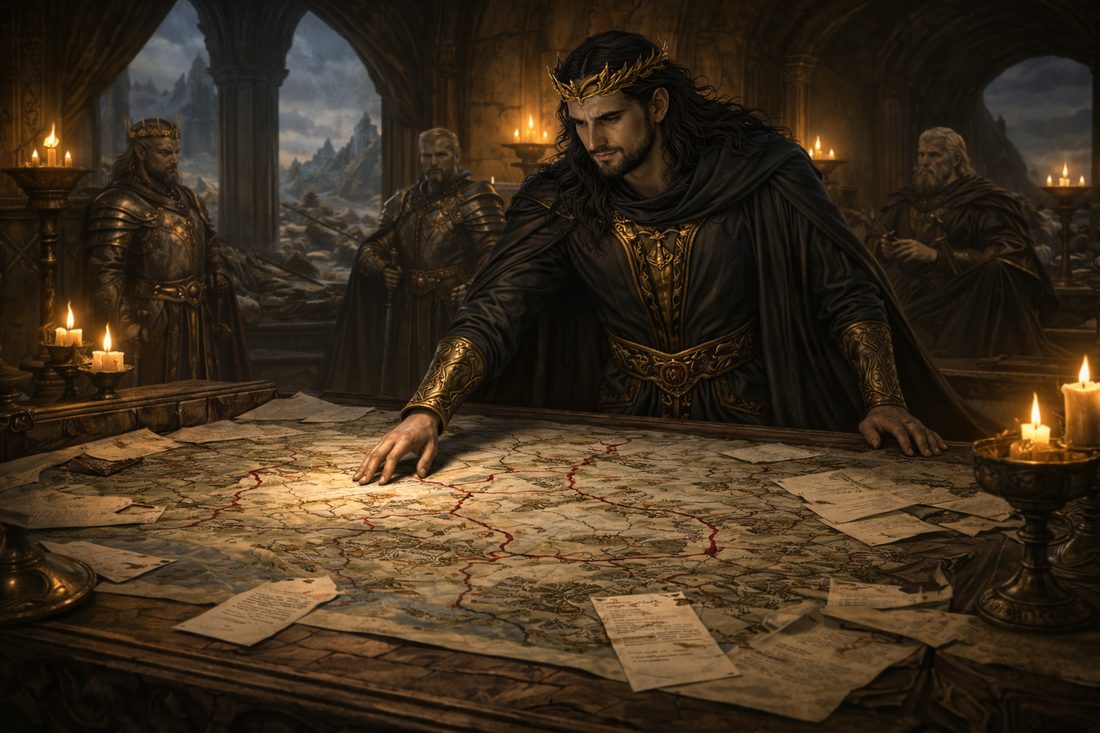
He marked red lines where routes had once been.
The red lines formed spokes.
All pointing toward Heaven’s Throat.
When he brought his findings before Hansall, he did not accuse.
He displayed progression.
“These are not closures,” he said carefully. “They are dependencies.”
Hansall studied the pattern without speaking.
“If caravans must pass through a monitored corridor,” Ilaren continued, “that corridor can be
delayed.”
“If military messages require recalculated clearance,” he added, “response time shifts.”
“And if response time shifts,” Hansall said quietly, “trust shifts with it.”
Exactly.
Weeks later, a coordinated defense drill between Adamas and Godrian failed.
The signal reached Greywatch late.
Not missing.
Late.
Sinbad’s fleet responded to a serpent resurgence that had already been cleared by northern
infantry.
Duplicated effort.
Wasted supply.
Murmurs began.
“Communication breakdown.”
“Human inefficiency.”
“Regional miscalculation.”
Lazarus never corrected those assumptions.
He allowed them to ferment.
In private, he stood before a relief map carved into white stone.
He placed his hand over the carved ridge between Adamas and Greywatch.
“Isolation,” he murmured, “is cleaner than assassination.”
Across the chamber, Caligular watched with open approval.
Solomon, present but silent, said nothing.
He observed.
Lazarus preferred redirection.
Caligular preferred domination.
Solomon preferred inevitability.
Three temperaments.
One mountain.
Ilaren copied older maps by hand and stored them in a sealed chest.
Not because he expected revolt.
Because he wanted proof that roads had once led differently.
Months passed.
When Godrian requested reinforcement, the convoy was delayed by “landslide stabilization.”
When Sinbad requested royal confirmation for a treaty shift, the messenger arrived after the
council session had closed.
When Adamas rode personally to inspect the southern passes, he found them perfectly intact.
Too intact.
Too orderly.
No evidence of hostility.
Just efficiency.
And efficiency can suffocate quietly.
By the time open hostilities erupted years later, historians would argue the war began with a
border skirmish.
They were wrong.
It began when Adamas stopped receiving both generals at the same table.
It began when Sinbad began planning without waiting.
It began when Godrian began fortifying without confirmation.
It began when roads stopped allowing coincidence.
Lazarus did not need to strike Adamas.
He only needed to ensure that when the moment came, the King stood alone.
And the map, innocent and precise, would show nothing wrong.
That is how peace dies.
Not in flame.
In delay.
And Lazarus understood something most warriors never do.
If you control the routes, you control who arrives to save a king.
And who does not.
End of The Map That Lost Roads