The Knives Before the War
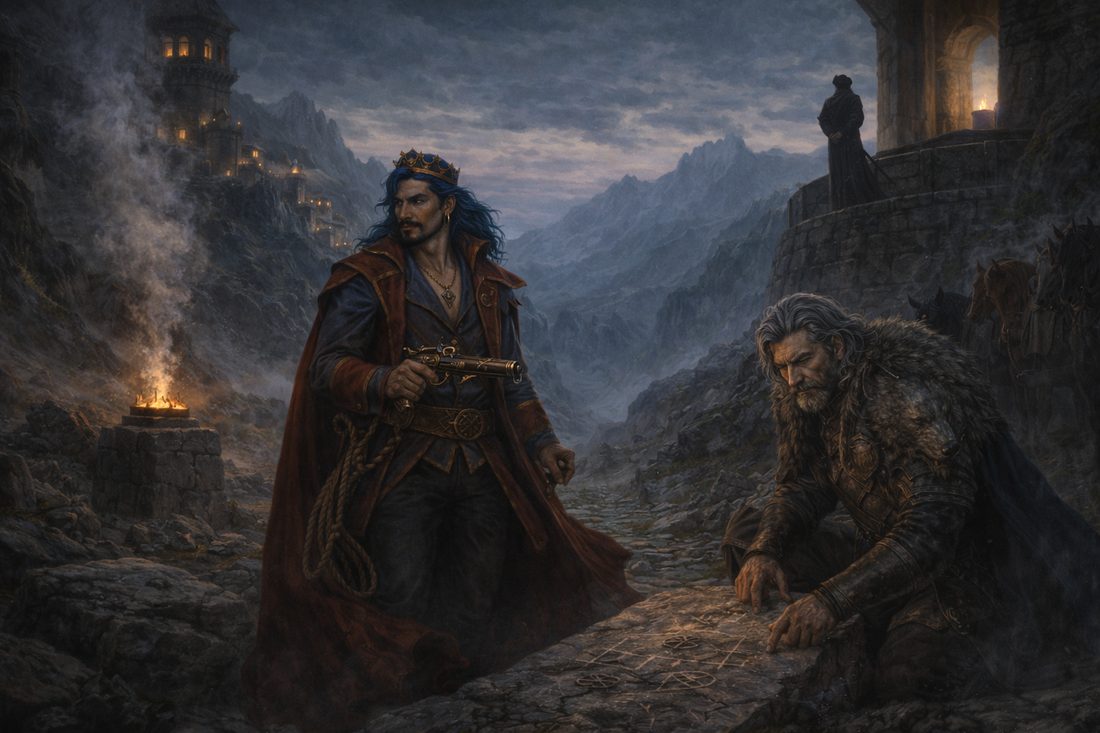
Sinbad Sinodess had learned long ago that maps do not lie in what they show. They lie in what
they normalize.
The coastal road should have been alive with motion. Fisher caravans hauling salted catch
inland. Tylon riders moving between tide and stone. Moon Elf couriers gliding in quiet rhythm
with the lunar pull. Instead, the road lay open and empty beneath a pale sky, wind dragging
loose sand across ruts that should have been fresh with wheels. No broken wagons. No spilled
cargo. No bodies left as warning. Only absence, clean, deliberate, undisturbed.
Godrian Greyhide dismounted without speaking. He knelt, pressing two fingers into the dust as
though the earth might confess what men would not. Sinbad watched the sea rather than the
road. The water was too calm for the tension he felt tightening along his spine.
“They did not scatter,” Godrian said at last. “No running. No pursuit.”
Sinbad nodded once. “Then they were removed.”
Not attacked. Not chased. Removed.
They followed the road inland, climbing toward the first stone ridges that marked the slow
beginning of Heaven’s Throat’s shadow. The air thinned as they rose. Sound carried too far.
Even their horses seemed reluctant to disturb the silence.
They found the watchtower before dusk.
It still stood.
That was the mistake.
The door hung open but unbroken. The signal brazier was cold yet neatly stacked with fresh
oil-soaked cloth, ready for lighting. Inside, three guards lay where they had fallen. No overturned
tables. No splintered beams. No defensive posture frozen into rigor.
Their eyes were open.
Sinbad felt something inside his chest harden.
Godrian crouched beside the nearest body, fingers hovering just above the skin without
touching. “No wounds. No swelling. No discoloration.”
“Poison?” Sinbad asked.
Godrian shook his head slowly. “No distress in the limbs. No clutching. Their bodies stopped.
Cleanly.”
Sinbad stepped back and let his gaze drift along the inner stone walls. That was when he saw
the lines, so faint they could have passed for natural weathering. Thin incisions. Precise.
Measured. They did not form a sigil or mark allegiance. They were placed at eye height, spaced
evenly, subtle enough that a bored guard might trace them idly without recognizing intention.
“They were observed,” Sinbad murmured.
Godrian rose. “They were tested.”
Not killed for territory. Not silenced for secrecy.
Tested.
Sinbad turned toward the narrowing pass ahead. “And we were meant to find this.”
They pressed forward.
The mountains tightened around them. Wind slid through stone corridors in low, unsettled tones.
The sense of being watched was not sharp, it was pervasive. As if the landscape itself had
begun to lean inward.
At the border stones, they were waiting.
Three figures in white steel etched with sun-gold filigree. Their armor bore no dents. Their
cloaks bore no dust. Their hands rested openly at their sides.
Not warriors.
Messengers.
The leader removed his helm, revealing a calm, disciplined face. “Generals,” he greeted with
measured respect. “We are relieved you have come.”
Sinbad did not dismount. “Relieved implies expectation.”
A faint smile touched the man’s mouth. “Stability requires predictability.”
Godrian stepped forward slightly. The air shifted, tightening almost imperceptibly around him.
“Why are my towers empty?”
“Regional instability,” the emissary replied evenly. “Storm displacement. Bandit opportunism.
Fragile alliances.”
Sinbad let out a short, humorless breath. “You are not subtle.”
“Subtlety is inefficient when acknowledgment is required,” the emissary answered.
There it was. Not denial. Not apology. Declaration.
“You want something,” Godrian said.
“Yes.”
The simplicity of it unsettled more than aggression would have.
“You are drawing us south,” Sinbad said slowly.
The emissary inclined his head a fraction.
Godrian’s jaw tightened. “To what end?”
“Our High Chancellor desires dialogue.”
“Lazarus,” Sinbad said.
“Yes.”
“Then he should speak to Adamas.”
The emissary’s eyes held steady. “Adamas listens to you.”
The words settled heavily between them.
Sinbad felt the shape of it forming. Each disruption along the coast. Each vanished caravan.
Each silent tower. None catastrophic. None large enough to justify full mobilization. Just enough
to demand attention. Just enough to require investigation. Just enough to bind the generals to
the south.
“You are measuring distance,” Godrian said quietly.
Silence answered him.
Sinbad’s thoughts sharpened. While they rode to inspect disturbances, while they reinforced
weakened corridors, while they ensured no new corruption festered in neglected passes,
Adamas would remain at the council clearing. Waiting. Honoring a tradition others had begun to
ignore.
The emissary stepped back. “We encourage continued inspection of southern routes. Additional
irregularities have been reported.”
“Of course they have,” Sinbad replied.
The emissary’s gaze cooled, though his voice remained smooth. “Tell your King we value
stability.”
The message beneath the courtesy was unmistakable.
We value separation more.
They let the emissaries leave. There was nothing to strike. Nothing to seize. No confession to
carry north. Only pattern.
That night, beneath bare stone and a wind that refused to settle, Sinbad stared into a fire that
burned low and stubborn.
“They are not preparing for war,” he said.
Godrian ran a cloth slowly along his blade. “No.”
“They are positioning.”
“Yes.”
“To isolate him.”
Godrian did not look up. “Yes.”
Sinbad felt the trap not as a snap, but as a tightening wire. If they abandoned the southern
corridors, more instability would follow. If they stayed, distance would grow. Either choice fed the
design.
“And if we ride north now?” Sinbad asked.
“They escalate,” Godrian answered. “Elsewhere.”
Responsibility was the leash.
Far to the south, in the high halls of Heaven’s Throat, Lazarus stood before a sprawling map
illuminated by controlled amber light. Red markers glowed softly along coastal roads, mountain
passes, trade arteries, none indicating armies. Only interruptions. Delays. “Irregularities.”
He moved one marker a measured inch east.
“Ensure the eastern supply line reports structural compromise,” he instructed quietly.
A subordinate bowed. “Total obstruction?”
“Delay,” Lazarus said. “Not collapse.”
“And the western watch posts?”
“Minor disturbances. Enough to require review.”
The subordinate hesitated. “And Adamas?”
Lazarus’s gaze lifted toward the open arch where distant peaks cut into a dim horizon. “He will
go where honor demands.”
“And his generals?”
“They will go where duty binds.”
The subordinate lowered his head.
“When the King stands alone,” Lazarus continued calmly, “we will speak.”
No malice edged his voice. Only inevitability.
Back in the pass, Sinbad watched the northern sky and felt, for the first time, not the fear of
open battle but the dread of being maneuvered.
Knives were not being sharpened for war.
They were being arranged for conversation.
And conversation, when one side stands alone, can cut far deeper than steel.
End of The Knives Before the War