The Generals Who Could Not Leave
Sinbad Sinodess had always mistrusted calm water. Storms announced themselves. Tempests
gathered, roared, and broke. But a sea that lay flat and gleaming beneath a pale dawn sky,that
was when ships vanished without spectacle. That was when trade faltered without visible cause.
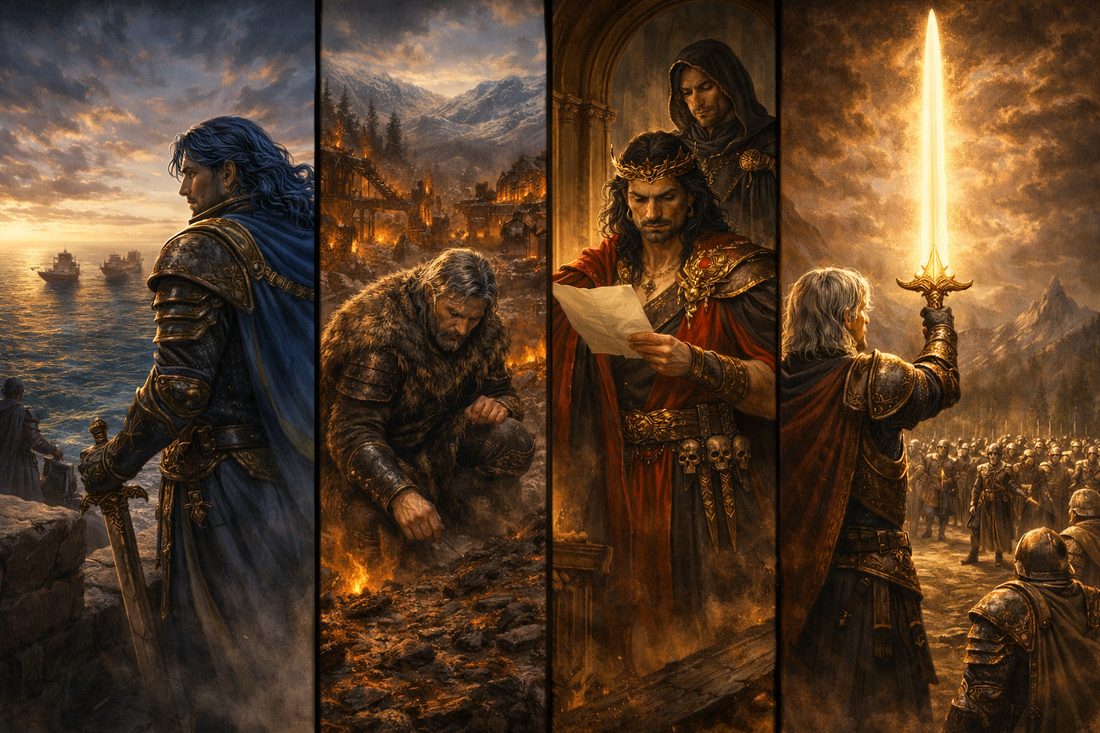
He stood on the western ramparts of Tylon’s harbor with the wind tugging lazily at his blue hair,
eyes fixed on the horizon where three merchant vessels should have been returning with the
tide. They did not arrive. They had not been attacked in open water, no wreckage had washed
ashore, no distress fires had been sighted. They had simply failed to complete the final stretch
home. The courier who delivered the report looked more frightened by the absence of violence
than by any bloodshed. Pirate activity had resumed farther south, he explained,organized,
selective, efficient. Cargo taken. Crews spared. Hulls left drifting. No slaughter. No message
carved into corpses. Just disruption calibrated to strain the arteries of trade without provoking
outright war. Gods Blood observers had already offered assistance in the straits, arriving with
uncanny timing. Sinbad read the parchment twice, jaw tightening almost imperceptibly. He had
intended to ride inland within the week, to stand beside Adamas at the reconvened council
clearing after years of silence. The invitation had been measured, almost respectful,Lazarus’
hand unmistakable in its careful neutrality. For the sake of stability, let us reconvene. It had
sounded like a restoration of balance. Now the coast required him. If he abandoned it, the straits
would choke within days. Merchants would panic. Alliances would fray. He issued orders
calmly,double escorts, cutters armed and ready, lighthouse garrisons reinforced,yet beneath the
discipline of command a quiet realization settled into him like sand in a boot. The timing was
immaculate. Too immaculate. Still, suspicion without proof was poison. He would not abandon
his post on instinct alone. Duty held him in place more effectively than chains.
Far to the north, Godrian Greyhide stood among the blackened remains of a supply depot that
had burned from within. Snow around the perimeter remained untouched, pristine and
unmarked by the chaos one would expect from a true assault. He knelt, grey hair falling around
a face carved by years of campaign, and pressed his fingers into ash that bore no trace of
accelerant. The fire had been controlled, deliberate, contained to the structure itself. Reports
had multiplied over the past fortnight: tribal migrations shifting out of season, serpent cult
insignias resurfacing along forgotten ravines, small raids against caravans timed to test
response intervals. None catastrophic. None large enough to justify mobilizing the full northern
host. All of them disruptive. The eastern pass had collapsed during a tremor too mild to shatter
solid stone. Coincidences layered upon coincidences until they began to resemble intention.
Godrian felt the pull of the southern invitation like a distant drumbeat. He knew Adamas would
go. He knew Sinbad intended to ride. He had planned to follow once border tensions cooled.
Now cooling never quite arrived. Every time he prepared to depart, another controlled blaze,
another subtle disturbance demanded his presence. His captains watched him with quiet
expectation, aware of the council but unwilling to suggest abandoning unstable ground. He
chose containment. Reinforcement. Patience. He did not voice the unease forming behind his
sternum, because leaders of the north did not chase shadows. Yet as he gave orders to hold the
ridge and fortify the pass, he could not ignore the sense that someone understood precisely
how much pressure the region could withstand without breaking,and was applying exactly that
measure.
High above them both, in the disciplined calm of Heaven’s Throat, Lazarus reviewed reports
beneath vaulted stone that carried no echo. He did not fabricate crises. He selected existing
fractures and encouraged them to widen at carefully measured rates. Coastal instability required
only subtle redirection of response windows. Northern disturbances needed only amplification
through rumor and strategic absence. He issued no command for slaughter, no order for overt
aggression. “Sustain,” he instructed evenly. “Do not escalate.” His subordinates hesitated only
once, questioning whether the generals might perceive pattern. “They will,” Lazarus replied
without irritation. “But they will not abandon their responsibilities.” That was the fulcrum upon
which everything balanced. Duty was stronger than suspicion. The second message to Adamas
had been drafted with almost excessive courtesy: Bring only minimal escort. Let this not
resemble provocation. It read as deference. It functioned as isolation. Lazarus understood
Adamas’ nature as clearly as he understood terrain. The king believed in shared law, in public
legitimacy, in the power of presence over intimidation. He would not arrive at a peace council
flanked by an army. He would arrive as a sovereign among equals, even if equals had thinned.
Adamas rode beneath an autumn canopy that filtered light into muted gold. Time had sharpened
him rather than diminished him. His white hair caught the wind. The blue gem set in his armor
glimmered like contained sky. Word from Sinbad had come first,coastal instability, temporary
delay. Godrian’s message followed,northern containment required, reinforcements underway, he
would ride south as soon as the line stabilized. Both communications were composed,
measured, devoid of alarm. That, more than anything, troubled him. They were men who did not
dramatize threat. If they remained in place, it was because they believed they must. He had
considered postponement. He rejected it. Absence would validate separation. If the Alliance
was to breathe again, someone had to show up. As he neared the old clearing, something felt
subtly altered. The forest was too still, its undergrowth trimmed back just enough to suggest
maintenance. The council stones had been restored to geometric precision, moss stripped
away, cracks sealed. The clearing did not look weathered by time. It looked curated. He
dismounted and ordered his small escort to hold position. The central stone felt faintly warm
beneath his gauntlet, as though it had recently known many hands. When the figures stepped
from the treeline, they did so without theatrics. White steel caught filtered light. Sun motifs
gleamed along disciplined ranks. Hundreds emerged in silence, forming a crescent that mirrored
the old council arcs with unsettling symmetry.
Lazarus walked at their head, expression composed, posture unforced. There was no raised
voice, no proclamation of accusation. “You came,” he said simply. Adamas studied him for a
long breath, measuring the distance between courtesy and inevitability. “You invited,” he replied.
Lazarus inclined his head slightly. He spoke of clarity, of resolving division before instability
consumed the age. He spoke as though arbitration were still possible, as though the assembled
host were precaution rather than preparation. When Adamas asked where his generals stood,
Lazarus answered without hesitation. “Occupied.” It was not delivered with triumph. It was
stated as fact. In that single word lay the architecture of the trap. Not violence. Not ambush in
the crude sense. Just timing. Alignment. Isolation. The ranks behind Lazarus adjusted almost
imperceptibly, shields settling, feet grounding. Adamas felt the air tighten,not with fear, but with
recognition. They believed numbers constituted inevitability. They believed he would yield
authority for the sake of preserving visible peace. For a moment the clearing held its breath
between two philosophies of order.
Then the light came.
It did not explode outward. It unfolded, concentrated and precise, gathering beside Adamas’
outstretched hand as though answering a call long deferred. The radiance condensed into
form,edge, hilt, brilliance contained within a blade that seemed forged from dawn itself. The
Sword of Light manifested without tremor, without spectacle beyond its undeniable presence.
The front ranks flinched despite discipline. Lazarus’ eyes sharpened, calculation recalibrating in
real time. He had accounted for resolve. He had accounted for isolation. He had not accounted
for divinity summoned without witness. When the first line advanced at his command, the
clearing that had once hosted debate prepared to host something far older. Far away along
salt-swept ramparts and snowbound ridges, two generals paused in the midst of their
containment efforts, sensing,not hearing,that something foundational had shifted. They did not
yet know that by fulfilling their duties, they had arrived precisely where Lazarus intended them to
remain. And in the forest where alliances once renewed themselves through conversation,
inevitability finally took a visible shape in steel and light.
End of The Generals Who Could Not Leave