The First Human Fear
The elves did not try to be intimidating.
That was the cruelty of it.
They moved through the settlement as though the grass welcomed them. Robes brushed stems
that bent and straightened without protest. Their laughter carried clean and unstrained. Even
their silence felt intentional.
To the humans, everything felt intentional.
The settlement itself was still raw. Timber frames not yet weathered. Woven roofs patched
where rain had tested them. Clay ovens that held fingerprints in their sides. Smoke that clung
stubbornly to skin and hair.
Children ran barefoot and came home with scraped knees.
The elves did not scrape.
They did not stoop.
They did not hurry.
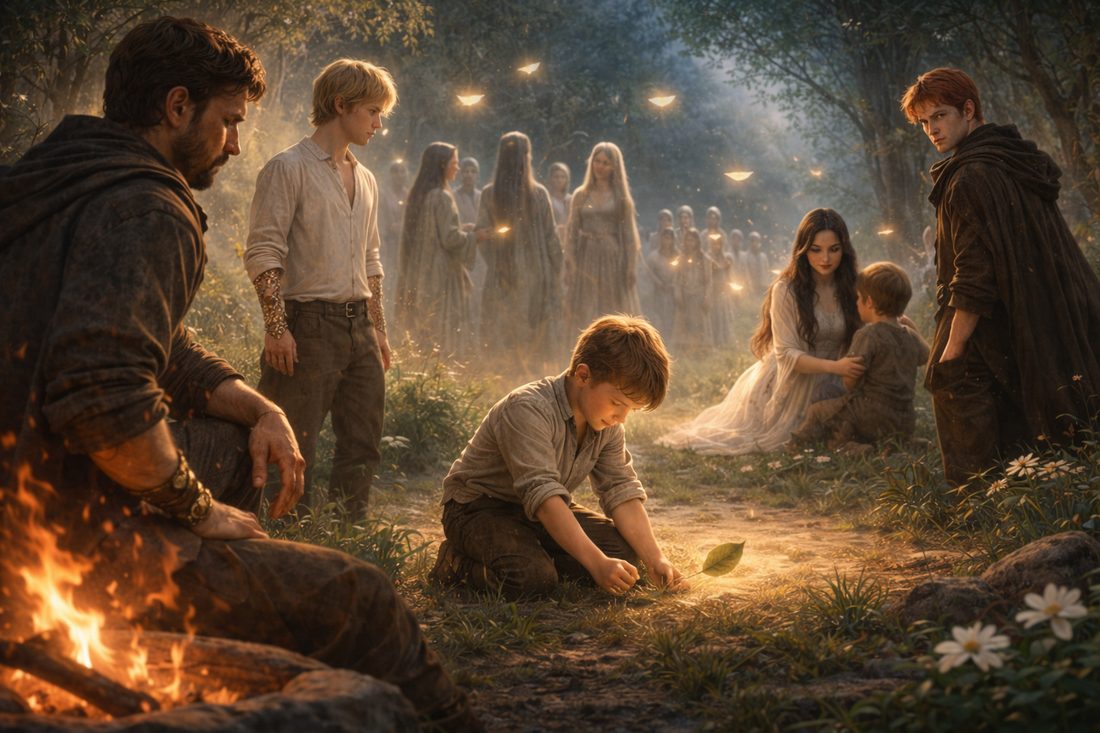
Rethan stood at the edge of the clearing and watched High Elf children practice shaping near
the orchard. Fallen leaves lifted at their gesture, rising softly into the air. The young elves turned
them into glowing lanterns that drifted like fireflies.
They were not showing off.
They were not performing.
They were simply doing what came naturally.
His son watched from behind his leg.
Later, when the orchard had emptied, the boy stepped into the same space. He bent, picked up
a leaf, and copied the motion he had seen.
The leaf did not move.
The boy laughed once, embarrassed.
He tried again.
Nothing.
Rethan looked away as though he had not seen.
He had fought beside elves during the serpent raids near the marsh. He had watched one of
them hold a writhing creature in place with a whisper while dragonfire reduced it to cinder. He
had felt gratitude then.
Gratitude feels different when your child is measuring himself.
That evening, the humans gathered around cookfires. Smoke drifted low. Roots roasted over
flame. The smell of bark and char clung to everything.
Across the clearing, the elves sang.
The song was soft and layered, older than the trees that bordered the settlement. It did not
demand attention. It simply filled the space.
“They live longer than we do,” someone muttered near the fire.
“Much longer,” another answered.
“Forever?” a young voice asked.
An elder shook his head. “Not forever.”
“But long enough.”
Rethan stared into the coals.
He did not fear the elves.
He feared the way standing beside them altered a man’s posture.
His wife approached quietly. She had spent the afternoon with Evalon, learning which herbs
slowed infection and which soil welcomed certain grains.
“She is kind,” Rethan said.
“Yes.”
“Kindness does not make us equal.”
He had not meant to say it aloud.
His wife watched the elves across the clearing before answering.
“No.”
The word did not carry bitterness.
Only fact.
Across the grass, an elf knelt before a human child and spoke gently, face open, expression
patient.
The child looked up with awe.
Not kinship.
Rethan felt the chill then.
“We are not as strong,” he said.
“No.”
“We are not as graceful.”
“No.”
“We will not live as long.”
His wife hesitated.
“Not yet,” she said.
The answer unsettled him more than certainty would have.
He had heard murmurs among younger men. Not rebellion. Not hatred.
Questions.
Why were they shaped this way?
Why must they learn from those who would never need them?
Why should they always follow the example instead of set it?
Across the firelight, Cainan stood apart, watching the elves without softness in his expression.
When spoken to, he answered, but his gaze returned to them quickly.
Abel stood near the orchard, speaking with an elven youth as though no difference separated
them.
Two brothers.
Two directions.
Rethan’s son tried again.
He raised his hand, mimicked the elven gesture carefully, jaw set tight with concentration.
The leaf trembled.
Only a little.
But it lifted from the ground before falling again.
The boy’s face broke into wonder.
Rethan felt something twist inside him.
The elves did not notice.
They were not diminishing the humans.
They were not asserting superiority.
They simply were what they were.
And for the first time, Rethan understood a new kind of fear.
It is possible to be protected and still feel small.
It is possible to be taught and still feel behind.
He looked at his son, at the trembling leaf, at the careful imitation of elven posture.
Something formed in him.
Not anger.
Not yet.
Hunger.
If we are the youngest, he thought, then we must grow faster.
If we are weaker, then we must learn deeper.
If we are short-lived, then we must burn brighter.
The fire cracked and shifted.
Across the clearing, Cainan’s gaze remained fixed on the elves.
And in that gaze, fear had already taken root.
Not fear of monsters.
Fear of inadequacy.
The kind that does not shout.
The kind that waits.
The kind that will one day accept any hand that offers it a key.
End of The First Human Fear