The Brother Who Waited
Solomon did not attend the battlefield.
He could not.
By the time word reached Heaven’s Throat, Lazarus was already dead and the clearing had
been emptied of its fallen. The survivors did not speak loudly when they returned. They did not
exaggerate. They did not defend themselves.
They reported.
Adamas stood alone.
Adamas killed hundreds.
Adamas wielded something that pierced divine protections.
Adamas executed Lazarus without hesitation.
They spoke it plainly.
Which made it worse.
Solomon listened without moving. He did not interrupt. His hands rested against the long table
in the council chamber, fingers splayed, as though steadying himself against a tremor only he
could feel.
“Was he wounded?” Solomon asked at last.
“Yes.”
“Gravely?”
“Yes.”
“And yet he survived.”
“Yes.”
The chamber felt smaller.
Solomon dismissed them.
He remained alone with the torches burning low and the great window open to the mountain
wind.
Lazarus had believed in inevitability.
He had believed the world could be shaped before it resisted.
He had believed Adamas could be removed like a keystone.
He had been wrong.
Solomon did not weep.
He replayed the failure instead.
Isolation had worked.
The generals had been delayed.
The escort reduced.
The clearing prepared.
Everything correct.
Everything precise.
And still,
Adamas had prevailed.
That was the problem.
Not that he was powerful.
But that he was principled.
The mortal races did not rally because they feared him.
They rallied because he restrained himself.
As long as Adamas lived, the world trusted.
As long as he walked, no mortal coalition would fracture completely.
As long as he breathed, Heaven’s Throat could not advance openly.
Solomon felt the truth settle like frost inside his lungs.
They could not move while he lived.
The realization did not cool him.
It burned.
He went to Lazarus’s chamber alone that night. The room had not yet been stripped. The maps
remained. The correspondence stacked neatly. The ink still wet on unfinished memoranda.
Lazarus had been careful.
Lazarus had been patient.
Solomon was neither.
He overturned the table in a single violent motion. Scrolls scattered. A brazier toppled and rolled
sparks across stone.
He stood over the wreckage breathing hard, something raw and animal rising in his chest.
“Destiny,” he whispered bitterly. “Destiny requires strength.”
“Destiny,” came a smooth voice behind him, “requires endurance.”
Solomon did not turn immediately.
Lord Cavendish Crowley had not been present during the ambush. He had not opposed it. He
had not endorsed it loudly either. He had simply remained near the margins, observing.
He stepped lightly over the fallen scrolls, dark attire immaculate, expression thoughtful rather
than mournful.
“You grieve,” Crowley said.
“I calculate,” Solomon replied.
Crowley smiled faintly. “Good. Then calculate this: you cannot defeat Adamas directly.”
Solomon’s jaw tightened.
“Not now,” Crowley continued gently. “Not while he commands loyalty and breath. He has
become myth. Myth must decay before it can be replaced.”
“And we wait?” Solomon demanded.
“We endure,” Crowley corrected. “And we prepare.”
“For what?” Solomon snapped.
“For inevitability.”
Crowley bent and lifted one of Lazarus’s discarded maps. His gaze skimmed it without interest.
“There are forces older than councils,” he said quietly. “Forces that do not require public
mandate.”
Solomon looked at him sharply.
Crowley’s tone never shifted from calm reflection.
“Grief can harden into purpose,” he continued. “Or it can be… redirected.”
Solomon said nothing.
Crowley met his eyes.
“You know the name,” he said softly.
The name had lived in the margins of forbidden texts. In the oldest records of divine fracture.
Baal.
Devil King.
Sovereign of structured rebellion.
Solomon felt something tighten in his chest, not fear.
Possibility.
“You suggest supplication,” Solomon said flatly.
“I suggest alliance,” Crowley replied. “Temporary. Private. Strategic. There are protections Abel
can pierce. There are others he cannot.”
Silence hung between them.
Outside, wind scraped across the mountain terraces.
“Adamas will not live forever,” Crowley said at last. “Mortal strength fades. When he passes, and
he will, there will be a vacuum.”
Solomon’s eyes darkened.
“And if we are prepared when that moment comes,” Crowley continued, “the world will not
fracture. It will transition.”
“Transition into what?” Solomon asked.
Crowley’s smile returned, thin and careful.
“Order.”
Solomon did not answer.
But he did not dismiss him either.
That was enough.
In the years that followed, Adamas did not march on Heaven’s Throat.
He did not seek vengeance.
He rebuilt.
He walked among mortal courts with visible scars and unhidden weariness. His wife Evalon
remained at his side, steadfast, luminous in quiet ways the Gods Blood never fully understood.
As long as they lived, war did not ignite.
Tensions simmered.
Borders shifted subtly.
But no open conquest began.
The Gods Blood trained.
Expanded infrastructure.
Reorganized command under Crowley’s precise administration.
And Solomon studied texts that had once been sealed.
He told himself it was contingency.
He told himself it was defense.
He told himself Lazarus’s death demanded strength.
Sometimes he dreamed of the clearing.
Of Abel’s light piercing armor that should not fail.
Of Lazarus falling.
He would wake with his heart racing and Crowley’s words echoing faintly:
Myth must decay.
Years passed.
Adamas aged.
His hair silvered fully.
His steps slowed.
Evalon’s laughter grew softer but never vanished.
The mortal races remained safe beneath his presence.
But Heaven’s Throat waited.
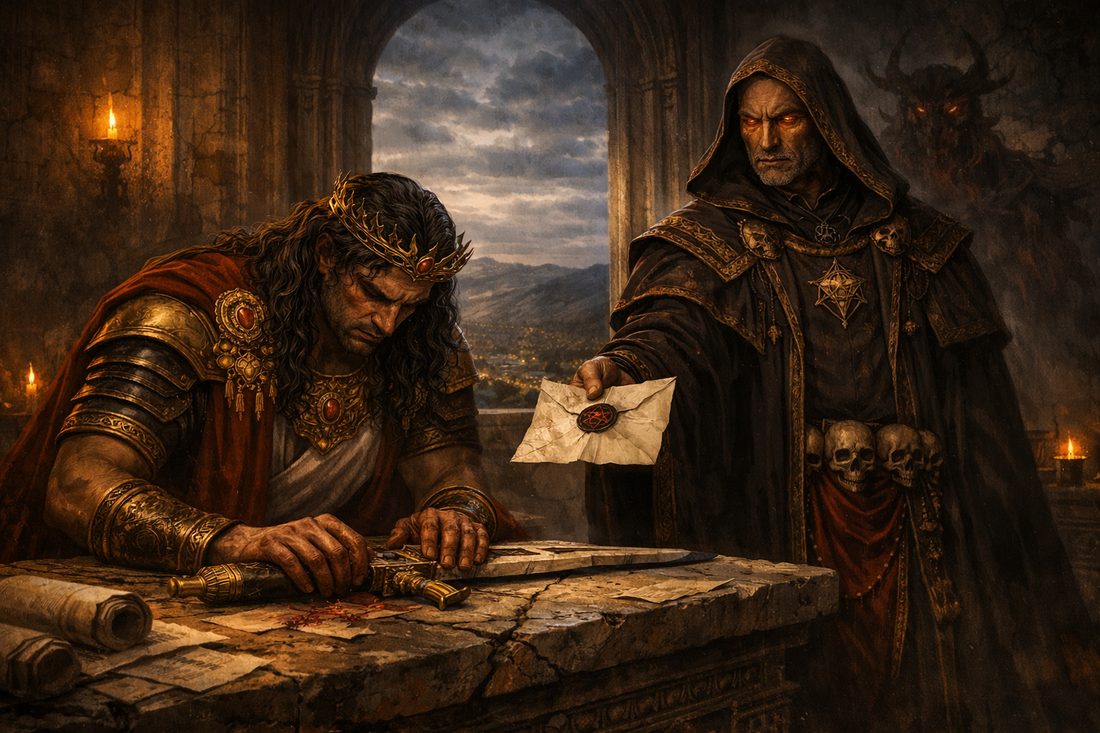
And then, one evening, a sealed letter arrived.
It bore no divine sigil.
No mountain crest.
No celestial seal.
Only a crude mark pressed in dark wax.
Crowley received it first.
He broke the seal privately.
His expression did not change as he read.
He carried it to Solomon without comment.
Solomon read it once.
Then again.
Then a third time.
The letter was brief.
It named grievances.
It named blood.
It named inheritance.
And it was signed,
Cainan.
Firstborn son of Adamas.
The son who had never forgiven.
The son who believed strength had been squandered on lesser races.
The son who believed humanity should rule.
Solomon looked up slowly.
Crowley’s eyes were unreadable.
“Myth,” Crowley said softly, “is most vulnerable from within.”
Outside, beyond Heaven’s Throat, Adamas still lived.
Evalon still walked beside him.
The world still breathed safely beneath their shadow.
But somewhere beyond mortal sight, a new alignment had begun.
And this time,
It was not grief that would ignite it.
It was inheritance.
End of The Brother Who Waited